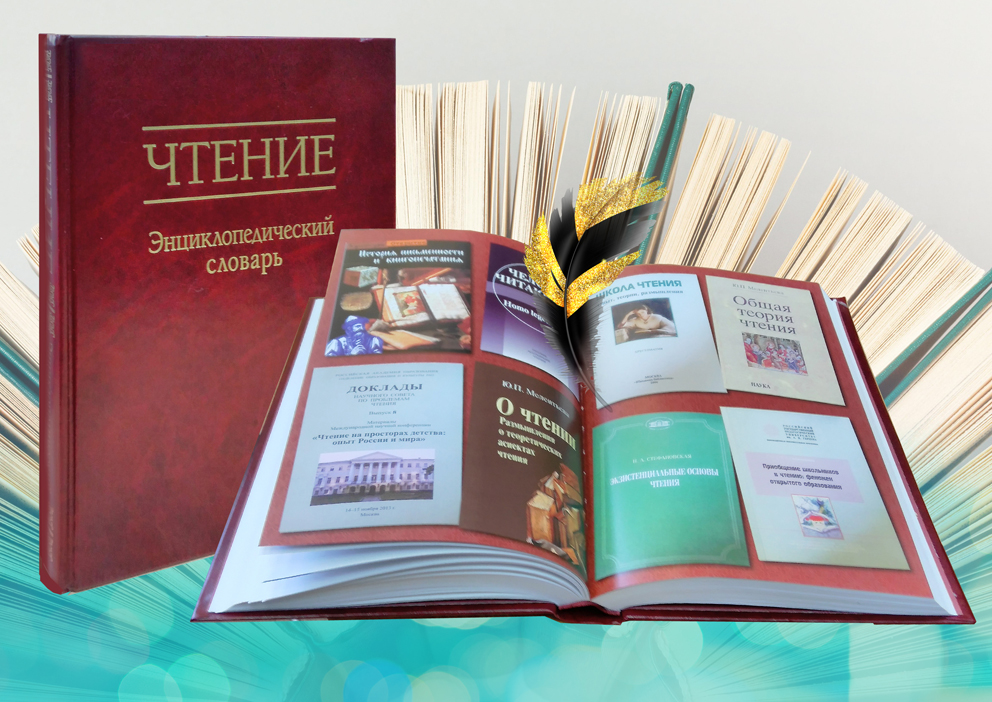
"The Reading. Encyclopedic Dictionary"
Margie and Tommy leafed through a crumpled yellow book. It was fun.
The letters in it stood still, did not run anywhere,
like those that glided across the TV screens.
If you turn the page back, it turned out that the printed words did not disappear from there,
and you can re-read them again and again.
Isaac Asimov. What fun they had. 1951
Dear friends,
We are pleased to introduce you to a new book. Come and meet Beauty!
The Scientific Library of the Novosibirsk State University has received a new edition, " The Reading. Encyclopedic Dictionary". The world of reading is presented in this book in all its diversity. Of course, this appearance in our library life is a joyful event! And we especially want to share it with readers right now, in April.
Let's remember that the April Eves are full of expectations of warmth and the coming Summer, the play of light and shadow. These days are also full of metaphysical dreams of peace and comfort, of Universal harmonies, of Infinity and Prosperity.
How consonant with the April mood are the poems of the great poet Nikolai Zabolotsky:
You brought the violin
And made me sing on the flute,
Then, grabbing my shoulder, you led me
Through the blue April fields...
So, these are "spring notes" about spring impressions!
So, before us is a book about reading. It is dedicated to the phenomenon, which is so familiar in cultural and everyday life, but still remains something incomprehensible. Together with you, dear friends, we will go on a journey into the world of reading, where in its space-time we, like travelers, are expected to meet, discover, riddle and come into contact with the unknown.
A minstrel beetle gallops across the field,
A butterfly flies, standing on pointe shoes.
Falling apart on the books, April
Рut on cornflowers, like aiguillettes...
Nikolai Zabolotsky
It is at the present time of total virtuality that the problems of reading are especially acute. The professional library community is seriously concerned about the problems of youth reading, in particular, the decrease in the level of interest in the book. Traditional ideas about reading have faced challenges to the culture itself and also to the person. So what is reading? Incomparable joy, a dimension of human life that is not fully known yet. A world whose God is Man.
I want these lines
Forgot that they are words
And turned into the sky, roofs, wind,
Raw pavement wood!
I want from the open page,
Like from an open window
There was a light, birds singing,
Breath of life.
Vladimir Sokolov
Such an edition of the "Encyclopedic Dictionary" on the problem of reading appears in Russia for the first time! Its task is to summarize the accumulated knowledge about the phenomenon of reading in various scientific fields: philosophy, psychology, pedagogy, philology, book science, library science, physiology, etc.
The relevance of the publication of the "Dictionary" is determined by the fact that the phenomenon of "reading" has become the subject of study of a number of sciences. The purpose of the book is to present this knowledge in a concentrated form, which makes it possible to see the whole picture of the world. Reading is a complex phenomenon, the foundation of civilization, just like writing is a necessary component of the political, economic, and humanitarian development of any state.
Without texts and reading, science and technology are impossible, and hence the entire modern civilization. It is also the basis for the full development of a person. Man, as noted by V. A. Lektorsky, Academician of the Russian Academy of Sciences, is not just a natural, but a natural-artificial being. He lives in three worlds: "the external world of physical things and events, the subjective world of consciousness and the symbolic-sign world", which Karl Popper, one of the most influential philosophers of science of the XX century, called the "third world". He brings "the individual beyond himself and attaches to universal ideas and values."
Reading is a unique way of reproducing a cultural tradition and a means of expanding individual experience. The authors of the book believe that it will give impetus to research work in this area. As a well-known linguist A. A. Reformatsky said: “terminology is a tool with which scientific theories, principles, and provisions are formed.”
The "Dictionary" includes 371 definitions. The head of this project is Yulia Petrovna Melentyeva. Her name is widely known in the professional library community. She is one of the most authoritative modern scientists in the field of library science, Doctor of Pedagogical, Professor, Corresponding Member of the Russian Academy of Education.
Melentyeva's scientific activity is aimed at studying the theoretical problems of reading as a social, sociocultural and civilizational phenomenon. Her theoretical work largely contributes to the formation of a professional worldview of a modern librarian - a thinking, creative, searching one.
Melentyeva contributed to the study of the history of Russian reading traditions and the identification of the features of modern reading culture. We believe that she is not just the head of the book, but also his soul.
The publication has its own target audience, addressed to researchers, teachers, teachers, librarians, graduate students, students, as well as to everyone who loves reading. The book is waiting for you, dear readers, in the methodology room of the NSU Scientific Library (room 106a), classroom building.
The Reading: Encyclopedic Dictionary / Russian Academy of Sciences, FGBUN NRC "Nauka" RAS, Dep. of Reading Problems, Russian Academy of Education, Department of Education and Culture, Scientific Council on Reading Problems of the Russian Academy of Education; [ed. Yu.P. Melentieva]. - Moscow: Nauka, 2021 438, [1] p., [4] р. col.
The text: L. Ya. Distanova
Decoration: O. V. Koshevaya