Pushkin Day in Russia
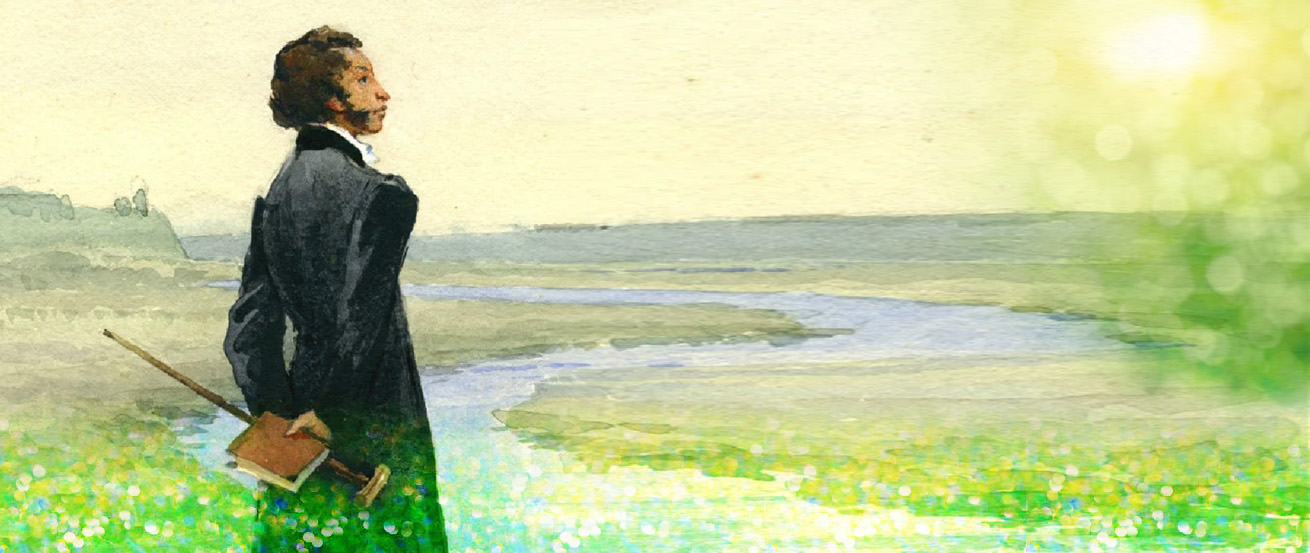
"As long as under the moon…"
"Pushkin is the clearest proof that the universal is comprehended only through the national. There is a
very great converging power in Pushkin. In today's bursting world, it is difficult to find a more urgent task.
Pushkin protects not only the connection of times, but also the connection of peoples"
Daniil Granin
Dear friends and readers of the NSU Science Library!
June 6, 2023 marks the 224th anniversary of the birth of the greatest Russian poet, playwright and novelist Alexander Sergeevich Pushkin. Russian culture, Russian continuity and Russian self-consciousness, how much resonates for us in this life-giving name, uniting readers through generations with love for Pushkin as an eternal symbol! No wonder his birthday became UN Russian Language Day.
Alexander Sergeevich Pushkin is considered to be the founder of the national Russian literary language. After all, only having an intellectually and aesthetically powerful tool, he could create masterpieces of the art of words that are not inferior to Western models. But to fulfill this high purpose, one genius was not enough. It was necessary to master the great artistic achievements of the most developed Western literatures, which grew up on the basis of the cultural and historical development that the Russian poet did not have in his native country.
He fulfilled his high lot: in just over fifteen years of his creative career, he aesthetically mastered what, if we start counting from Dante, took more than five centuries in the history of the development of Western countries.
Organically connected with the traditions of Russian culture, Pushkin was at the same time an excellent connoisseur of French, navigating it no worse than any French writer of his era, had extensive knowledge in the field of Italian and English literature, showed interest in German and Spanish literature. The subject of his constant attention throughout his life was ancient culture. Folklore of various peoples attracted his attention. It is essential at the same time that all these interests were formed in the poet's mind into a single concept of world culture.
Russian art was the turning point when the reception of the world cultural experience by the Russian people was replaced by transmission, when Russian culture became the leading voice to which the entire cultural world had to listen. European culture noticed this change of roles only after hearing Tolstoy, Dostoevsky and Chekhov, but the coup itself took place under Pushkin and, to a large extent, thanks to his genius.
The Fiction Lending Library (room 301a, auditorium building) invites readers of the NSU Science Library to visit the exhibition dedicated to the birthday of the great poet, to touch together the height of his spirit, to try to catch the ever-acting mystery through the centuries, to perceive not only the portrait of the national Russian identity imprinted in immortal works, but also the psychology of the evolution of many other peoples, the concept of world culture.
Text by A. D. Kulikov, the Fiction Lending Library
Design: O. V. Koshevaya